Define your data once.
Trust it everywhere.

The problem
Three tools. Three answers. Zero trust.
Data Products
Raw tables become trusted Data Products
A Data Product is a governed dataset bundled with its business definitions, access policies, ownership, and lineage, treated like a product, not a one-off query.
- Discoverable in a shared catalog; any team can find and trust it
- Policy travels with the product: Role-based Access Control (RBAC), column masking, row-level security
- Versioned and tested: breaking changes reviewed before rollout
- Consumed by BI tools, APIs, and AI agents: same definition, every time
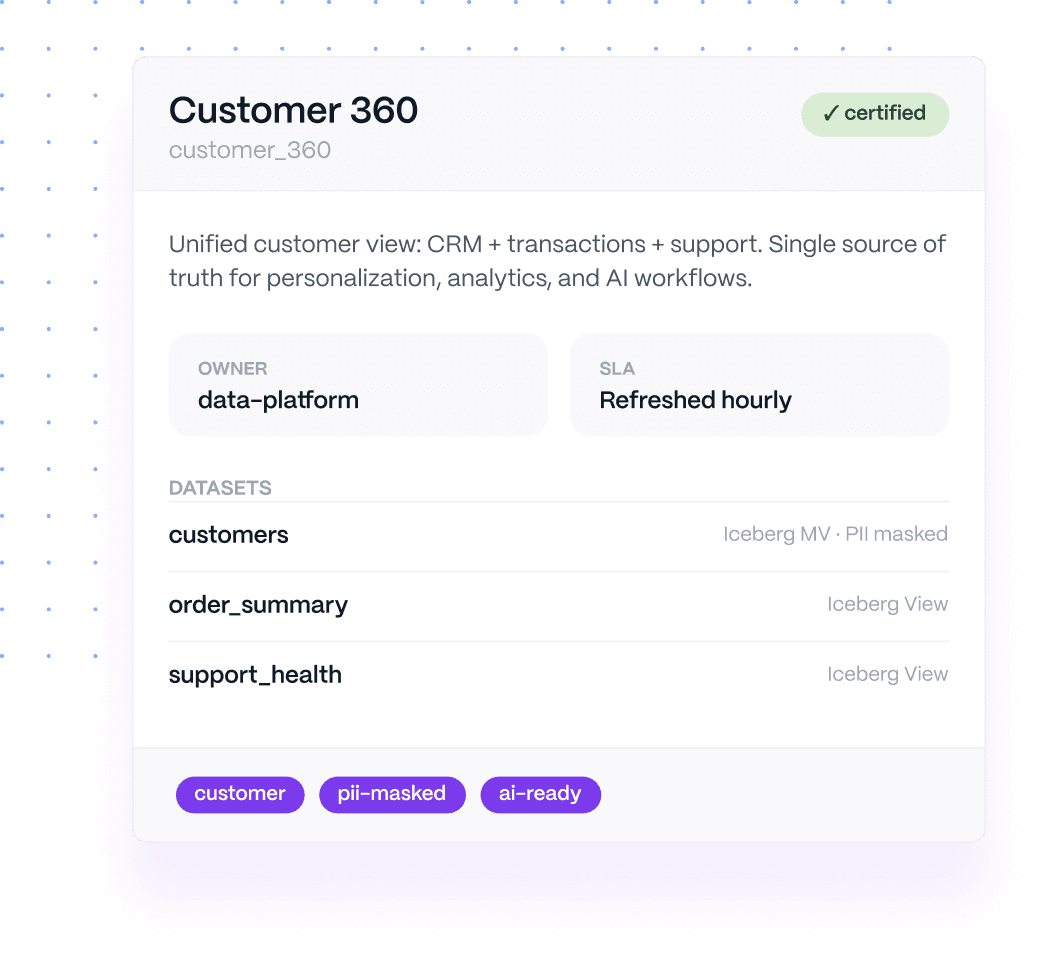
Data Products as code
Your business definitions. In git. In CI/CD.
Data Products can now be defined in YAML. Commit to git, test before merge, roll back when needed.
-- customer_360.sql
-- Increment version → triggers review workflow in CI

CREATE OR REPLACE DATA PRODUCT customer_360
  VERSION 2
  DESCRIPTION 'Unified customer view: CRM + orders + support'
  OWNER 'data-platform@acme.com'
  TAGS ('certified', 'customer', 'pii-masked')
  REFRESH SCHEDULE '0 * * * *'          -- hourly

DATASET customers
  MATERIALIZED                               -- Iceberg MV for performance
  DESCRIPTION 'One row per customer, masked PII'
AS
  SELECT
    c.customer_id,
    c.name,
    sha256(c.email)           AS email_hash,
    COUNT(o.order_id)         AS total_orders,
    SUM(o.amount)             AS lifetime_value,    -- canonical definition
    c.segment,
    c.region,
    MAX(s.health_score)       AS support_health
  FROM      crm.customers  c
  LEFT JOIN orders.line_items o ON c.customer_id = o.customer_id
  LEFT JOIN support.scores   s ON c.customer_id = s.customer_id
  GROUP BY 1, 2, 3, 6, 7;
Version control: Commit Data Product definitions to git alongside application code. Diff, review, merge.
Policy as code: Access rules live in the same repo as the definition. No separate admin console to remember.
CI/CD lineage checks: Validate upstream freshness automatically before publishing a new version.
The semantic layer
Your AI has no context. Data Products fix that.
The semantic layer translates raw data into business-ready context: metrics, dimensions, and relationships your tools and AI agents can trust. Data Products are that context layer, built into the query platform itself.
LLMs struggle with raw database schemas. They excel when given structured business context. Context, gained through the semantic layer, is what closes the gap between AI potential and AI accuracy.Starburst, What is the Semantic Layer?

Governed data products · Versioned · AI-ready
See what changes when intelligence reaches all your data.
Start free in minutes, or talk with a Starburst expert.
No credit card required.