Zero opsmaintenance.
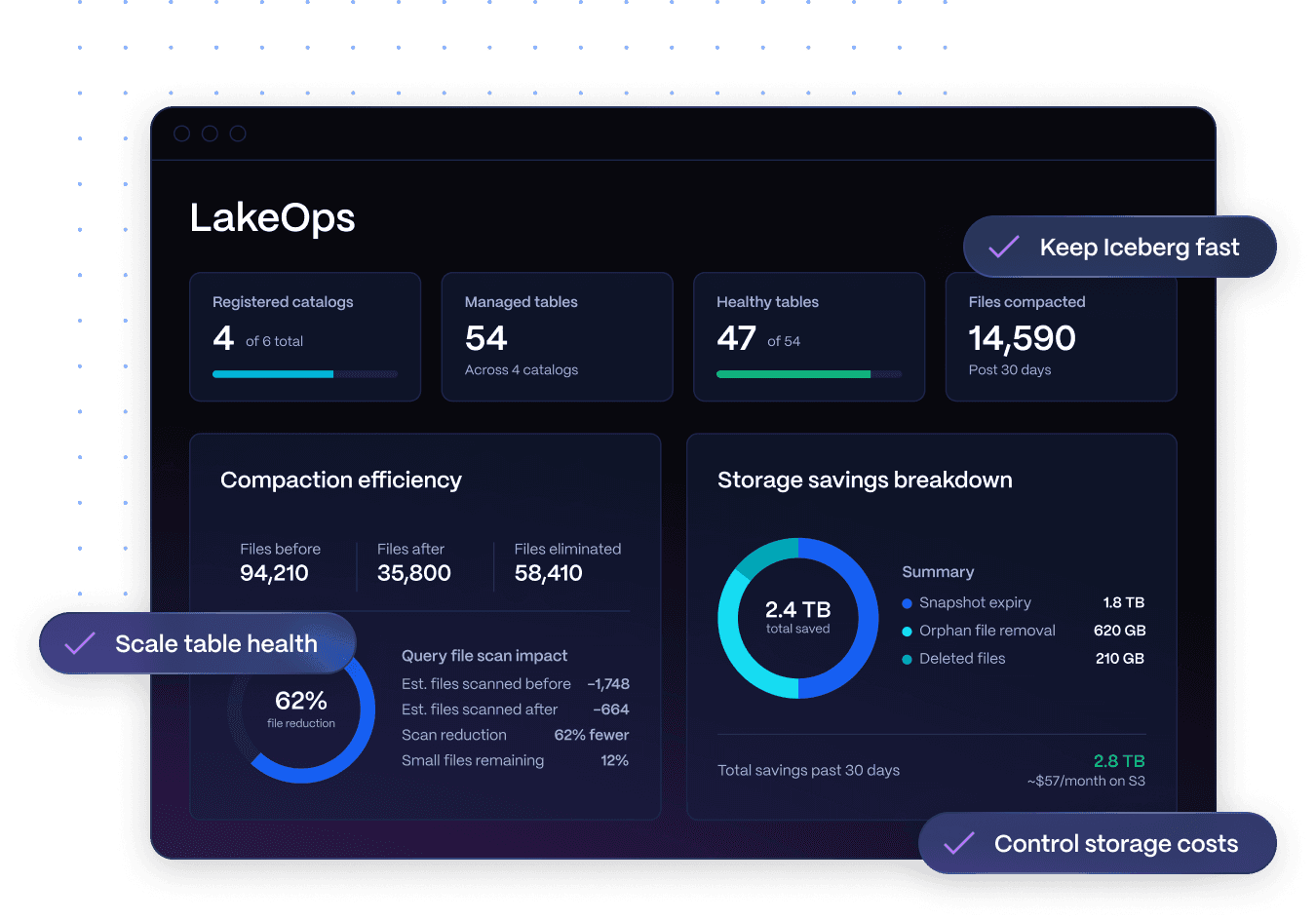
What LakeOps looks like
Every table, watched and kept healthy on its own
Every managed table is monitored and maintained on its own. One view shows its current health, recent maintenance runs, and upcoming work.

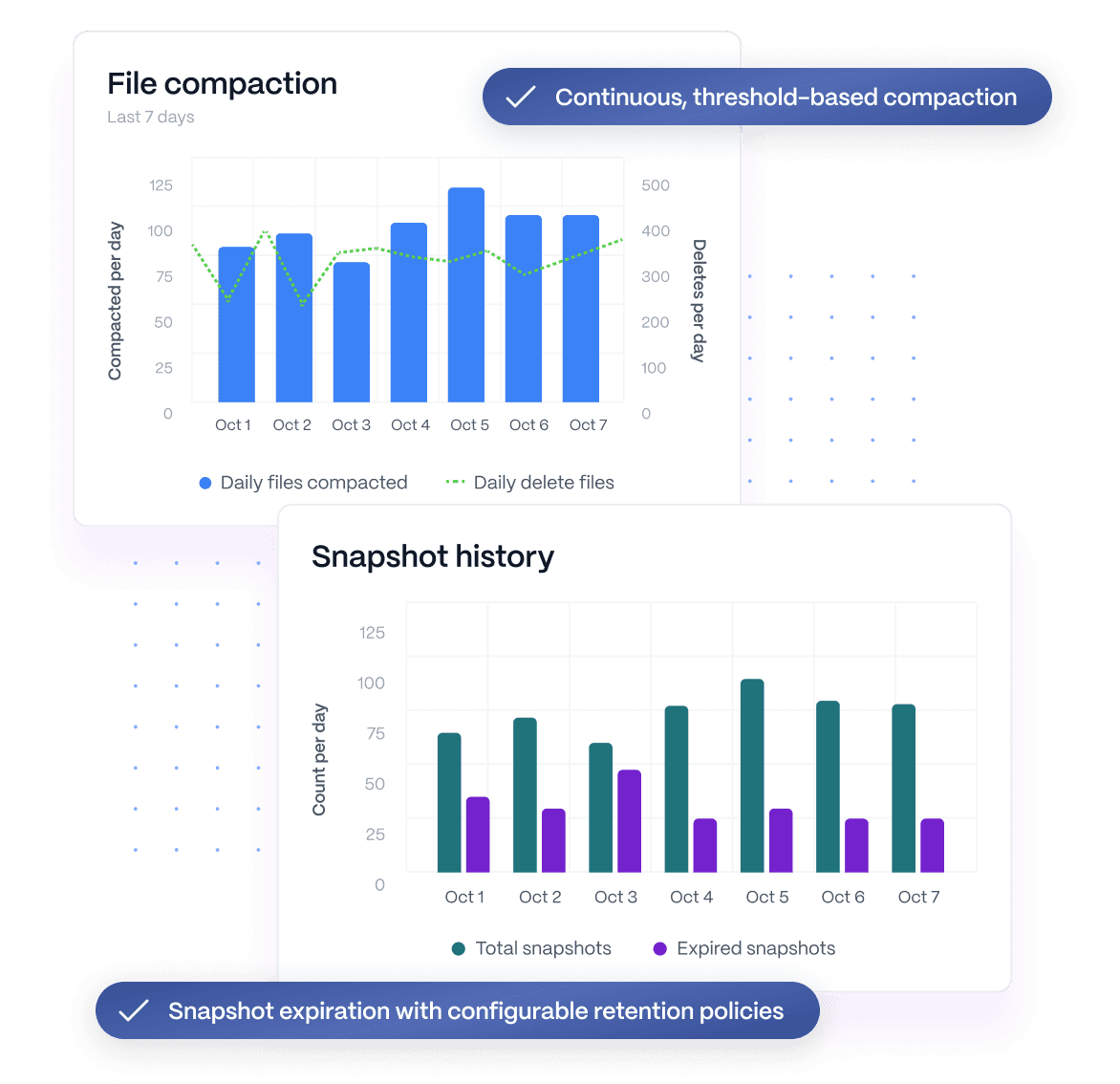
A table's life, two ways
Ten tables is a cron job. A thousand is a platform.
The same table, maintained by hand versus maintained by LakeOps. One gets worse until someone notices; the other doesn't.
A table maintained by hand
- Small files accumulate, unnoticed. Every streaming commit adds files. Nobody's watching for it.
- Query times quietly get worse. Scans slow down before anyone connects it back to file count.
- Someone schedules an OPTIMIZE job. A cron job or Airflow DAG is written, sized for this one table.
- Repeat, per table, forever. Multiply by every table in the lakehouse. Ten is manageable; a thousand is not.
A table maintained by LakeOps
- LakeOps watches table state. Every table is asked continuously: is there work to do?
- Compaction runs the moment it's needed. Not on a clock, only when file count or delete ratio crosses a threshold.
- Snapshots and orphan files clean up automatically. Retention policy applies itself; storage doesn't quietly grow.
- Stays this way, at any scale. The same platform handles ten tables or ten thousand, without more headcount.
The four operations
Native support for the Iceberg spec, not a workaround for it
Compaction, snapshot expiration, manifest rewriting, and orphan file removal, handled the way Iceberg intends, automatically.
Data compaction
Combines small files into larger ones and sorts unsorted files to improve query performance.
Snapshot expiration
Expires old snapshots on your retention window, freeing files no longer needed for time travel.
Manifest rewriting
Consolidates small manifests so query planning opens fewer objects, not more.
Orphan file removal
Reclaims storage from files left behind by expired snapshots or failed operations.
Who this runs for
What teams keep healthy with Icehouse LakeOps
01
Query performance recovery
Bring scan times back down after small files and delete files pile up from streaming ingestion.
02
Storage cost control
Reclaim storage from orphan files and expired snapshots that are quietly billed every month.
03
Compliance-safe retention
Expire snapshots on your own retention policy instead of keeping every version indefinitely.
04
Multi-engine lakehouses
Keep tables healthy no matter which engine wrote them: Spark, Flink, Trino, or Starburst.
05
Scaling past a thousand tables
Move from a per-table cron job to a platform that watches every table's state on its own.
06
AI & ML feature freshness
Keep feature tables compacted and current so pipelines and agents aren't scanning stale files.
Further reading
More on Icehouse LakeOps from the Starburst blog
Data Maintenance With Icehouse LakeOps
How LakeOps maps each way Iceberg degrades to a specific, automatic fix.
Read the postHow Table Maintenance Affects Iceberg Snapshots
What happens to metadata when you compact, expire, and remove orphan files.
Read the postIceberg Data Maintenance with Starburst
Why Iceberg's flexibility for fast writes comes with an ongoing maintenance need.
Read the postVisualizing Iceberg Snapshot Linear History
A working, visual deep dive into how Iceberg snapshots relate to one another.
Read the postIceberg Snapshots Affect Storage, Not Performance
Why a long tail of snapshots costs storage, not query speed, until you expire them.
Read the postBest Practices for Optimizing Apache Iceberg Performance
Scheduled compaction, snapshot expiration, and orphan file removal, kept query-ready by default.
Read the postStarburst unveils Icehouse LakeOps and Icehouse Ingest
The announcement introducing Managed Icehouse's two core capabilities.
Read the postGo deeper on Icehouse
Icehouse Overview
The full Icehouse architecture: Starburst, Iceberg, and metastore optionality.
Explore the Icehouse OverviewIcehouse Ingest
Stream Kafka topics and land S3 files into query-ready Iceberg tables.
Explore Icehouse IngestStop scheduling maintenance. Start ignoring it.
Point LakeOps at a catalog and watch your tables get healthier on their own.